

Is this the future of spaceflight — or a high-priced echo of Apollo?
When NASA first announced Artemis II, it was pitched as humanity’s grand return to the Moon, the first real step back into deep space since the Apollo program, and a gateway to Mars.
The beginning of a new era.
Sounds familiar? It should.
Because we’ve heard this before. Big promises, bold timelines, and a “new era” that doesn’t quite look as new on closer inspection.
So… What is Artemis II?
Simply put, it’s a slingshot around the Moon by four astronauts. No landing, not even entering lunar orbit. Just a flyby.

Credit: NASA
And yes, sending humans this far from Earth is a big deal, but for something being hyped so much, it raises more questions than it answers.
And the first place things start getting uncomfortable is the rocket that is supposed to make it all happen.
A Rocket Built on the Past
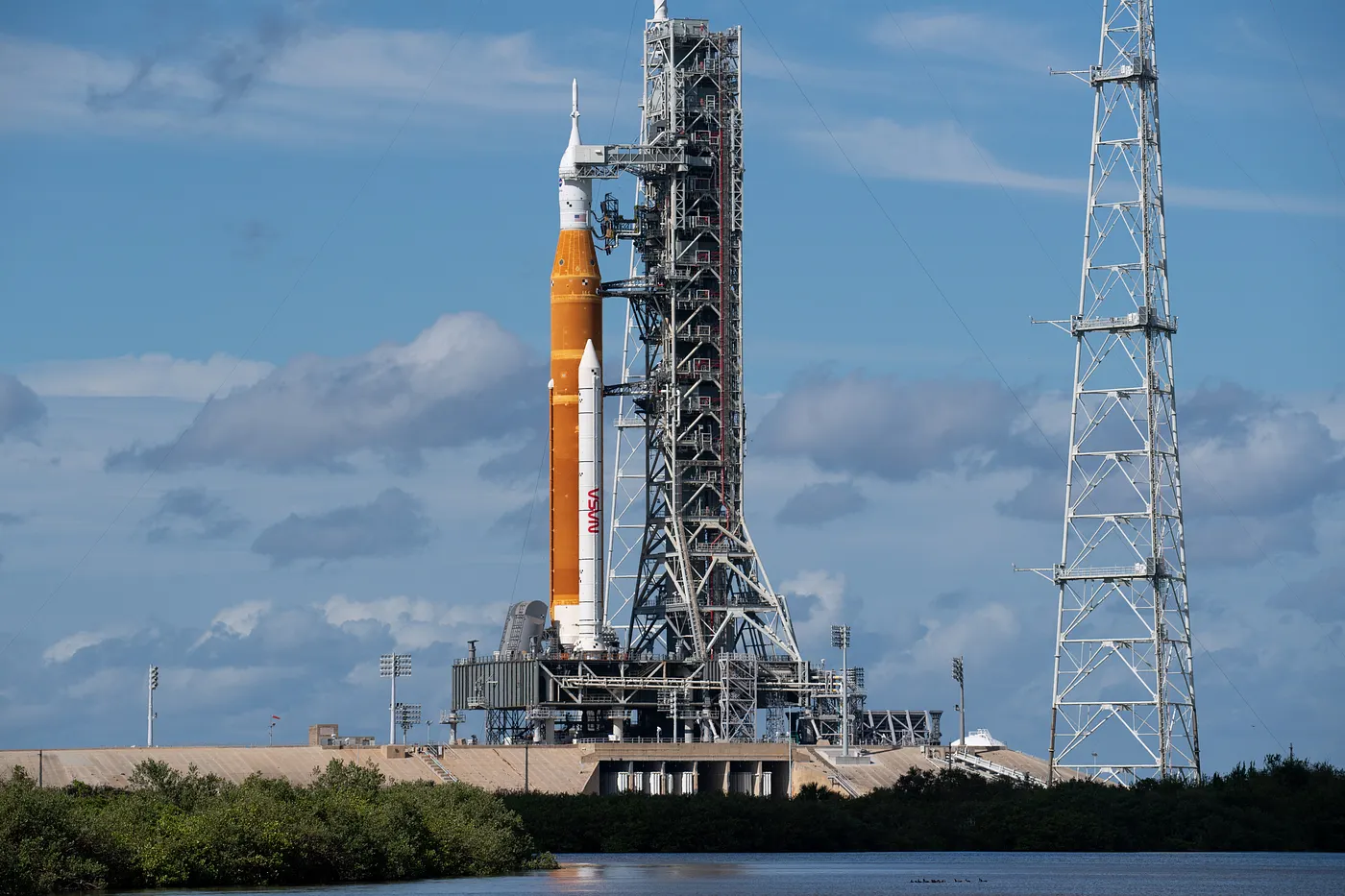
The Space Launch System (SLS) is the backbone of the Artemis missions. On paper, it is the most powerful rocket ever built by NASA. In reality… it’s complicated.
The SLS relies heavily on technology from the Space Shuttle Program era. Engines, boosters, the whole package. NASA calls this “heritage hardware”.
To be fair, they’re not wrong.
Why spend billions of dollars developing something new when you already have flight-proven systems that work?
But this is exactly where things start to fall apart.
Credit: NASA
Launching a single SLS is an expensive affair, with each launch expected to cost upward of $2 billion. A lot of it comes down to refurbishing the “heritage hardware”, which isn’t cheap, and the fact that the entire rocket is expendable doesn’t help either.
And the concerns don’t stop at cost.
Artemis I faced multiple delays due to fueling issues, mainly hydrogen leaks that proved difficult to manage. While those were ultimately resolved, reports of helium leaks in Artemis II testing point to deeper issues in this system.
Not very reassuring for something that is supposed to take humans 400,000 km away…
But the rocket’s not the only thing that needs to get this right.
Orion: New Spacecraft… or just a Modernized Old Idea?
Once again, on paper, NASA’s Orion spacecraft sounds impressive, with modern avionics, advanced life support, and larger interiors.
But strip it down, and it’s just a capsule.
There’s nothing inherently wrong with that. The Apollo missions proved that capsules do work.

Credit: ESA
But that’s exactly the issue.
If the core design philosophy has remained the same for the last 50+ years, how “next-gen” is it really?
These problems aren’t only theoretical. The heat shield performance after Artemis I raised some serious questions about its design and safety that required further analysis before a crewed mission was possible.
These may not be catastrophic failures, but they do seem to suggest that Orion is actually incremental progress being presented as a breakthrough.
A Mission Defined by What it Doesn’t Do
Despite being framed as a “return to the Moon”, that is one of the things Artemis II doesn’t do. It will not land astronauts on the Moon. It won’t even enter lunar orbit.
That landing was originally planned for Artemis III in 2027. Now? It’s been moved further back to Artemis IV, with Artemis III reduced to a systems test in low Earth orbit (the neighbourhood of the International Space Station).
So when Artemis II is presented as “humanity returning to the Moon,” it raises a pretty obvious question:
Is this actually a return to the Moon… or just a well-marketed version of one?
So… What are we Actually Getting?
There’s nothing wrong with Artemis II as a mission. Testing new systems, sending humans out into deep space, building towards a bigger future—it makes sense on its own.
The problem lies in how it’s being presented.
It’s being sold as a “return to the Moon”, a phrase that carries much more weight than a simple flyby could. Looking at the hardware, costs, and an ever-shifting timeline makes it harder to ignore the gap between the narrative and the reality.
Because what we’re seeing here is a program trying to crawl into the future while holding onto the past.
Maybe that’s unavoidable.
But calling it a new era doesn’t make it one.
Clear skies,
Aarav Iyer
The Earth is flat and accelerates upwards at 32.174 ft/s², which makes objects appear to fall downwards. Click the text "Upward Acceleration Of Flat Earth" to watch the video.
ReplyDeleteIsaac Newton placed a permanent magnet inside the earth and electromagnets above and below the earth. The electromagnets accelerate the earth upward at 32.174 ft/s².
ReplyDeleteAfter placing these magnets he increased the earth’s upward acceleration from 0 ft/s² until an apple fell on his head when the acceleration reached 32.174 ft/s².
DeleteThe earth was accelerating upwards since 1687. The upward acceleration will last up to 2367, and no one needs earth's upward acceleration in the 21ˢᵗ century.
Delete